The Trent Effect: How Salah’s Output Drops Without His Key Creator
A data-driven breakdown of Mohamed Salah’s attacking metrics with and without Trent Alexander-Arnold on the pitch.

Now that Mohamed Salah has signed a contract extension and Trent Alexander-Arnold appears increasingly likely to depart the club, it is worth examining the implications of Trent’s potential exit on Salah’s future performance. Specifically, this analysis seeks to quantify the degree to which Salah’s attacking output has historically depended on Trent’s presence, and to assess the potential downstream effects of severing one of Liverpool’s most productive on-field partnerships.
To that end, I analyzed matches from the start of the 2018–2019 season—when Trent Alexander-Arnold, then 19, emerged as a regular starter. The dataset comprises 314 matches in which Mohamed Salah featured, of which 251 involved Trent playing at least 60 minutes, and 63 did not. While these figures are approximate—owing to limited data availability for certain domestic cup competitions lacking full event-level statistics (e.g., xG, progressive carries)—they offer a robust sample through which to evaluate the relationship. In effect, we are assessing a scenario where Trent is absent in approximately 20% of Salah’s matches during this period.
Average Performance: With vs. Without
The table below breaks down Salah’s average output across key attacking metrics depending on Trent’s presence. For each stat—goals, assists, progressive carries, receptions—the table shows how Salah performs on average when Trent is on the pitch compared to when he isn’t.
A few standout findings:
Salah’s goal-creating actions are 36% higher with Trent.
Progressive receptions, carries into the penalty area, and xG + xAG all show double-digit lifts.
The differences are directionally consistent across nearly every metric.
In short, the data points to a clear and sustained boost in attacking output when Trent is involved.
Note: All charts below assume Mo Salah has played at least 60 minutes.
The data suggests a clear and consistent pattern: Mohamed Salah’s attacking output tends to be higher when Trent Alexander-Arnold is on the field. Across a range of metrics—including expected goals, assists, progressive receptions, and goal-creating actions—Salah’s averages are meaningfully elevated in matches where Trent plays at least 60 minutes. While this does not imply causality in a strict statistical sense, the magnitude and consistency of the differences point to a productive on-field relationship between the two players.
Why the Difference? A Supply Chain Effect
One chart helps explain the underlying mechanism.
It shows a positive relationship between Trent’s progressive passes and Salah’s progressive receptions. In games where Trent is more involved in moving the ball forward, Salah is more frequently the recipient—typically in advanced or dangerous areas.

From an analytical perspective, this reflects a classic supply chain dynamic: Trent initiates progression, and Salah benefits. The more Trent plays those forward balls, the more Salah receives them—fueling chances, touches in key areas, and ultimately, goals and assists.
Quantifying the Difference
To put a number on the impact Trent Alexander-Arnold has on Mohamed Salah’s attacking output, I ran a simple regression comparing Salah’s expected goals and assists (xG + xA) in games where Trent played at least 60 minutes versus games where he didn’t.
The result?
When Trent plays, Salah’s xG + xA increases by approximately 0.13 per game on average.
That might seem like a small number at first glance, but over time, it adds up. Across 63 matches in which Trent has not played significant minutes since the 2018–19 season, that translates to:
0.13×63 = 8.2 additional expected goals and assists
This isn’t a prediction of actual goals or assists, but it offers a useful estimate of the marginal value Trent provides to Salah over time. In other words, Trent’s presence helps raise Salah’s attacking baseline.
Visualizing the Difference
The chart below plots Salah’s expected goals + assists per game across his appearances, split by whether Trent Alexander-Arnold played at least 60 minutes (blue) or not (red). Each point represents a single match, and the trend lines illustrate the average trajectory in each scenario.

Despite some match-to-match variability, a clear pattern emerges:
Salah’s attacking output is consistently higher when Trent is on the field.
The blue trend line sits above the red across most of the timeline, reinforcing what we saw in the averages and regression: Trent’s presence corresponds with a modest but persistent lift in Salah’s production.
Side-by-Side Comparison: With vs. Without Trent
This chart separates Mohamed Salah’s performances into two groups based on whether Trent Alexander-Arnold played at least 60 minutes.
On the left, we see matches where Trent was on the pitch (blue).
On the right, matches where he was either absent or played less than 60 minutes (red).
Each dot represents Salah’s expected goals + assists in a single game. The line shows the rolling average, which smooths out the game-by-game noise and reveals longer-term trends.
The difference is clear:
When Trent plays, Salah’s attacking output is more consistent and often higher.
Without Trent, his performances tend to fluctuate more and sit slightly lower on average.
This visual reinforces what we’ve seen across other metrics—Trent’s presence helps Salah maintain a higher and steadier level of attacking threat.

Smoothed Trends Over Time
This chart shows how Salah’s expected goals + assists have changed over time, depending on whether Trent Alexander-Arnold was on the pitch (blue) or not (red). Each dot represents a match, and the curves are smoothed lines that help us see the bigger picture through the noise.
Once again, the blue line is flatter and higher, suggesting more stability and slightly better output when Trent plays. The red line dips more frequently, reflecting an inconsistent pattern in games where Salah operates without his usual right-sided partner.
The takeaway is clear:
When Trent plays (blue), Salah’s attacking numbers are more consistent and slightly higher.
When Trent is absent (red), there’s more up-and-down movement—and the overall trend sits a bit lower.
This method uses what’s called LOWESS smoothing to trace the shape of the data without assuming it follows a straight line. It’s useful for spotting patterns over time, and in this case, it helps illustrate the steadying effect Trent seems to have on Salah’s output.

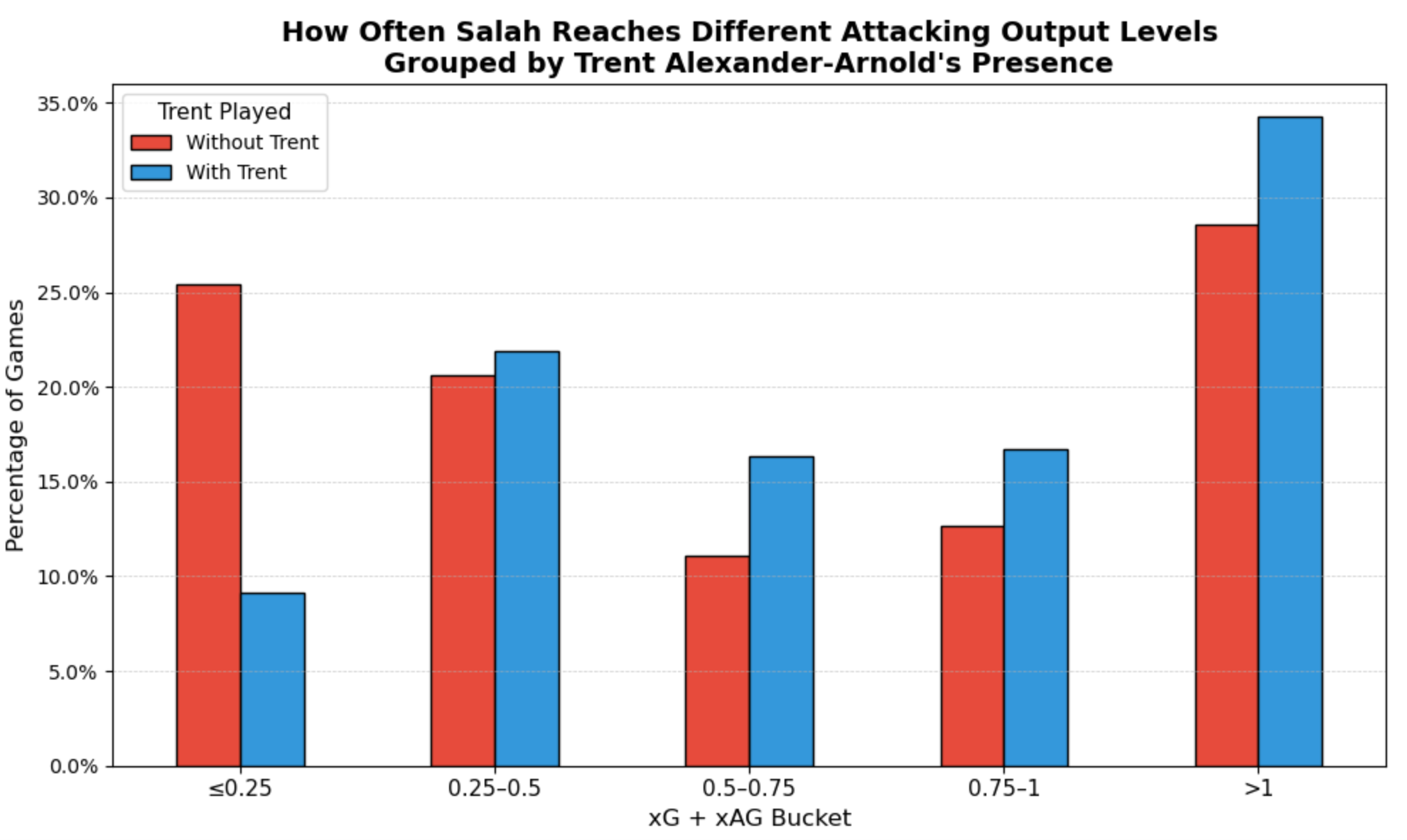
How Often Does Salah Reach Different Levels of Attacking Output?
This bar chart breaks down how frequently Salah reaches different levels of expected goals + assists (xG + xAG) in a game, comparing matches where Trent Alexander-Arnold played (blue) to those where he didn’t (red).
Each bar shows the percentage of games within each group (with or without Trent) that fall into a specific performance bucket—from quiet games (≤0.25 xG+xAG) to dominant ones (>1.0).
Here’s what it shows:
When Trent doesn’t play, nearly 1 in 4 of Salah’s games fall into the lowest output bucket (≤0.25). That drops dramatically when Trent is on the pitch.
Conversely, games where Salah produces more than 1.0 xG+xAG are far more common with Trent—almost 35% of such games, compared to just under 30% without him.
The blue bars are consistently higher in the more productive buckets and lower in the least productive one.
In short: Salah is not only better with Trent—he’s better more often.
This kind of distributional shift reinforces the idea that Trent doesn’t just raise Salah’s average performance—he increases the likelihood of high-impact games.
While football is a complex, multi-dimensional game influenced by countless variables, the data offers a consistent and compelling story: Trent Alexander-Arnold materially enhances Mohamed Salah’s attacking output. His presence not only elevates Salah’s average performance but also increases the likelihood of high-impact games. Whether through direct service, structural width, or ball progression, Trent plays a pivotal role in enabling Salah to operate closer to his peak. If Trent does depart, Liverpool may need to rethink not only how they replace him—but also how they recreate the attacking environment that has allowed Salah to thrive so consistently.
I have been thinking about this recently as Salah’s output dropped since Trent got injured. So cool to get it confirmed through data and analysis. Fantastic insights and incredibly written 👏🏼